
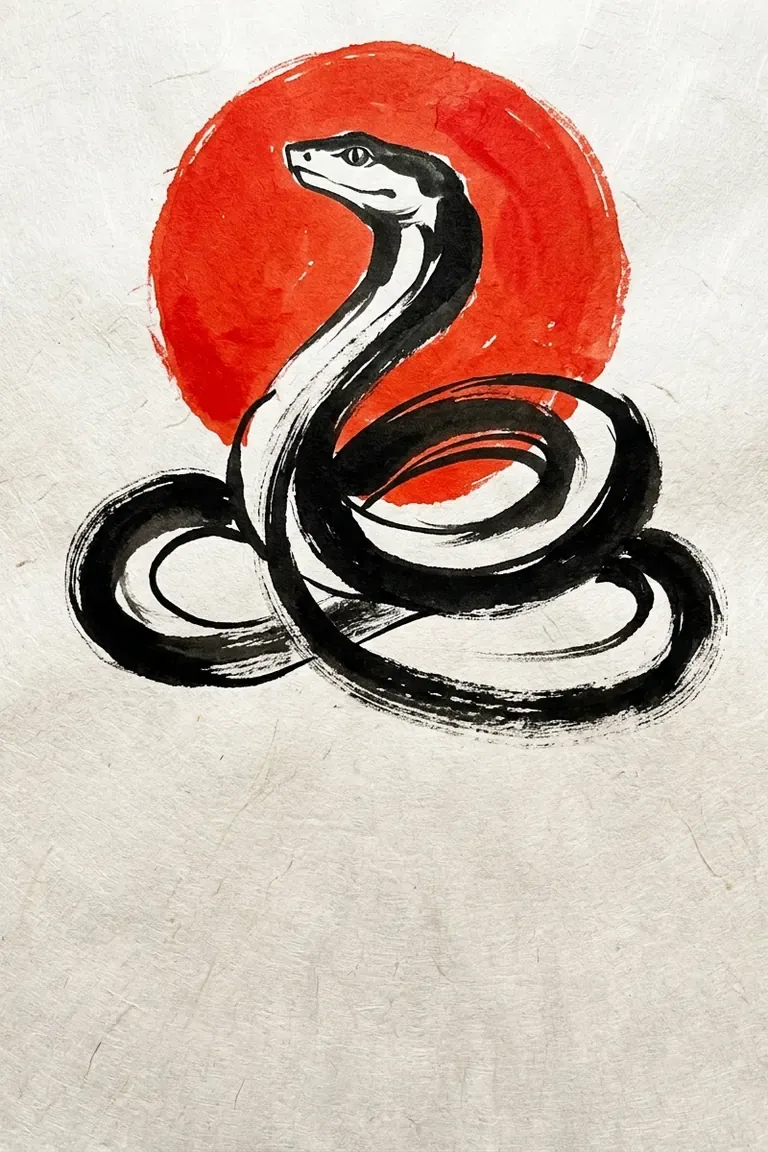
Sixth in the cycle
A page on chinaculture.org says the Snake is sixth in the Chinese zodiac. Key Concepts in Chinese Thought and Culture, from the Foreign Language Teaching and Research Press, says the twelve animals were associated with the twelve Earthly Branches. Combining the two, the entry gives the Snake as sishe (巳蛇).
A legend of Little Dragon and the first parents
The chinaculture.org page says the Snake is often respectfully called “Little Dragon”, because the dragon is said to have originally been modeled on the snake.
It also tells one Chinese legend: Fu Xi, the Descendant of the Dragon, and Nv Wa, the Descendant of the Snake, were the original father and mother of the Chinese people.
The White Snake on the opera stage
The same page describes a traditional Chinese opera, The Legend of White Snake. It tells of Bai Shejing, a magical snake able to turn herself into a beautiful woman named Bai Niangzi. In human form she walks along the banks of West Lake and meets the scholar Xu Xian, and the two fall deeply in love. She is imprisoned for many years under Leifeng Pagoda but never wavers in her love.
Sayings and traits
A second page on chinaculture.org says people tend to be afraid of snakes, as the saying “Bit once by a snake, scared by a piece of rope for ten years” reflects. It also says “Insatiable as a snake swallowing an elephant” describes extreme greed.
The same page describes people born in a Snake year as cool and collected, eloquent and tenacious, and unwilling to accept defeat. It says they also tend to be self-important and suspicious.
A National Museums Liverpool page, in which Billy Hui explains the significance of each zodiac animal, calls the Snake wise and very intense, and often vain with a fiery temperament. It adds that the Snake has different meanings for different parts of Chinese culture: some believe it is a strong protector, others that it can be untrustworthy.
A V&A blog post by Ming Wilson takes someone born in the Year of the Rabbit as its example and calls it a fairly recent development to say such a person has a certain character. The post says there is no mention of such a belief in old Chinese texts.
In art and in celebration
The same V&A post includes a Snake in earthenware from the Tang dynasty, and says this piece is from a set of zodiac animals modelled as having human bodies.
A Xinhua report on China Daily’s website says that as Spring Festival ushers in the Year of the Snake, China is flooded with auspicious representations of the hissing, scaly reptile, from pythons coiling around gold ingots to serpents with chubby faces and fluffy bodies. The report adds that the snake is shaking off its negative connotations and taking on a more auspicious and celebratory role.
Every Snake year, 1900 to 2100
Each row is one lunar year of the Snake, from its lunar new year to the day before the next one. The element comes from the stem of the year.
| Year | Stem-branch | Element | Yin or yang | Starts | Ends |
|---|---|---|---|---|---|
| 1905 | Yi-si 乙巳 | Wood | yin | 4 February 1905 | 24 January 1906 |
| 1917 | Ding-si 丁巳 | Fire | yin | 23 January 1917 | 10 February 1918 |
| 1929 | Ji-si 己巳 | Earth | yin | 10 February 1929 | 29 January 1930 |
| 1941 | Xin-si 辛巳 | Metal | yin | 27 January 1941 | 14 February 1942 |
| 1953 | Gui-si 癸巳 | Water | yin | 14 February 1953 | 2 February 1954 |
| 1965 | Yi-si 乙巳 | Wood | yin | 2 February 1965 | 20 January 1966 |
| 1977 | Ding-si 丁巳 | Fire | yin | 18 February 1977 | 6 February 1978 |
| 1989 | Ji-si 己巳 | Earth | yin | 6 February 1989 | 26 January 1990 |
| 2001 | Xin-si 辛巳 | Metal | yin | 24 January 2001 | 11 February 2002 |
| 2013 | Gui-si 癸巳 | Water | yin | 10 February 2013 | 30 January 2014 |
| 2025 | Yi-si 乙巳 | Wood | yin | 29 January 2025 | 16 February 2026 |
| 2037 | Ding-si 丁巳 | Fire | yin | 15 February 2037 | 3 February 2038 |
| 2049 | Ji-si 己巳 | Earth | yin | 2 February 2049 | 22 January 2050 |
| 2061 | Xin-si 辛巳 | Metal | yin | 21 January 2061 | 8 February 2062 |
| 2073 | Gui-si 癸巳 | Water | yin | 7 February 2073 | 26 January 2074 |
| 2085 | Yi-si 乙巳 | Wood | yin | 26 January 2085 | 13 February 2086 |
| 2097 | Ding-si 丁巳 | Fire | yin | 12 February 2097 | 31 January 2098 |
Sources
- Chinese Zodiac
- Chinese Zodiac
- The 12 zodiac animals at the V&A (V&A)
- The animals of the Chinese calendar (National Museums Liverpool)
- Slithering into celebration: Chinese people embrace snakes as new zodiac symbol (Xinhua)
- The Chinese Zodiac / Animal of the Year (Foreign Language Teaching and Research Press)