
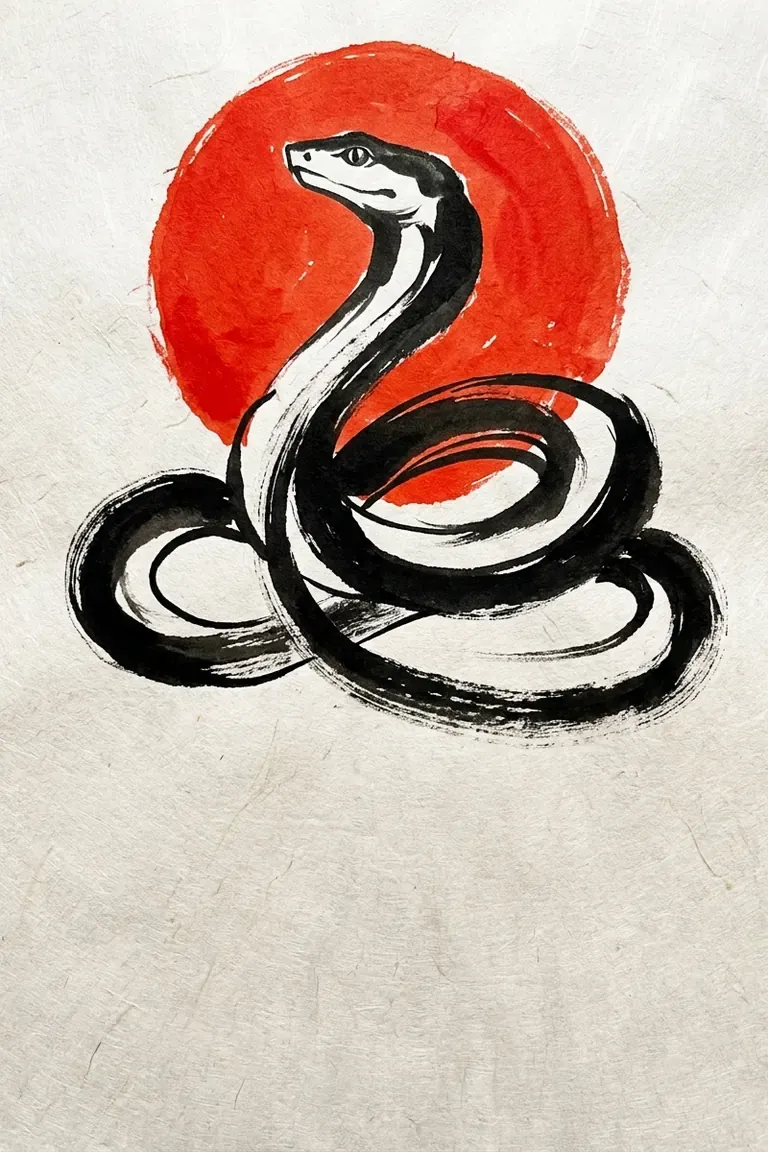
1941 is the year of the Metal Snake (yin), from 27 January 1941 to 14 February 1942.
1941 Chinese zodiac year at a glance
- Animal
- Snake 巳
- Element
- Metal
- Yin or yang
- yin
- Stem and branch
- Xin-si 辛巳
- Dates
- Monday 27 January 1941 to Saturday 14 February 1942
Born in January or February?
The Chinese year starts on the lunar new year, not on 1 January. If you were born from 1 January to 26 January 1941, your sign is the Metal Dragon of 1940, which began on 8 February 1940. From 27 January 1941 you are a Metal Snake.
The other side works the same way. The Metal Snake year ends on 14 February 1942, so people born from 1 January to 14 February 1942 are still Metal Snakes. From 15 February 1942 the sign is the Water Horse of 1942.
Nearby years
About the Snake
The Snake is often respectfully called "Little Dragon", because the dragon is said to have originally been modeled on the snake.
One Chinese legend says Fu Xi, the Descendant of the Dragon, and Nv Wa, the Descendant of the Snake, were the original father and mother of the Chinese people.
The traditional Chinese opera The Legend of White Snake tells of Bai Shejing, a magical snake able to turn herself into a beautiful woman named Bai Niangzi. In human form she walks along the banks of West Lake and meets the scholar Xu Xian, and the two fall deeply in love. She is imprisoned for many years under Leifeng Pagoda but never wavers in her love.
About Metal
The five phases exist in various cycles, the two most common being mutual generation and mutual conquest. In the generation cycle, earth generates metal (ore) and metal generates water (melting). In the conquest cycle, fire conquers metal (melting) and metal conquers wood (chopping).
Han thinkers used a "mutual production" series (earth produced metal, metal produced water) and a "mutual conquest" series (metal conquered wood, fire conquered metal).
Zou Yan and his followers used the conquest cycle to articulate their theory of dynastic transmission, in which a dynasty ruled by the power of the wood phase would be conquered by a new ruling house associated with metal, which in turn would be conquered by a dynasty of fire.
Try it with your birth date.
Find your Chinese zodiac sign