
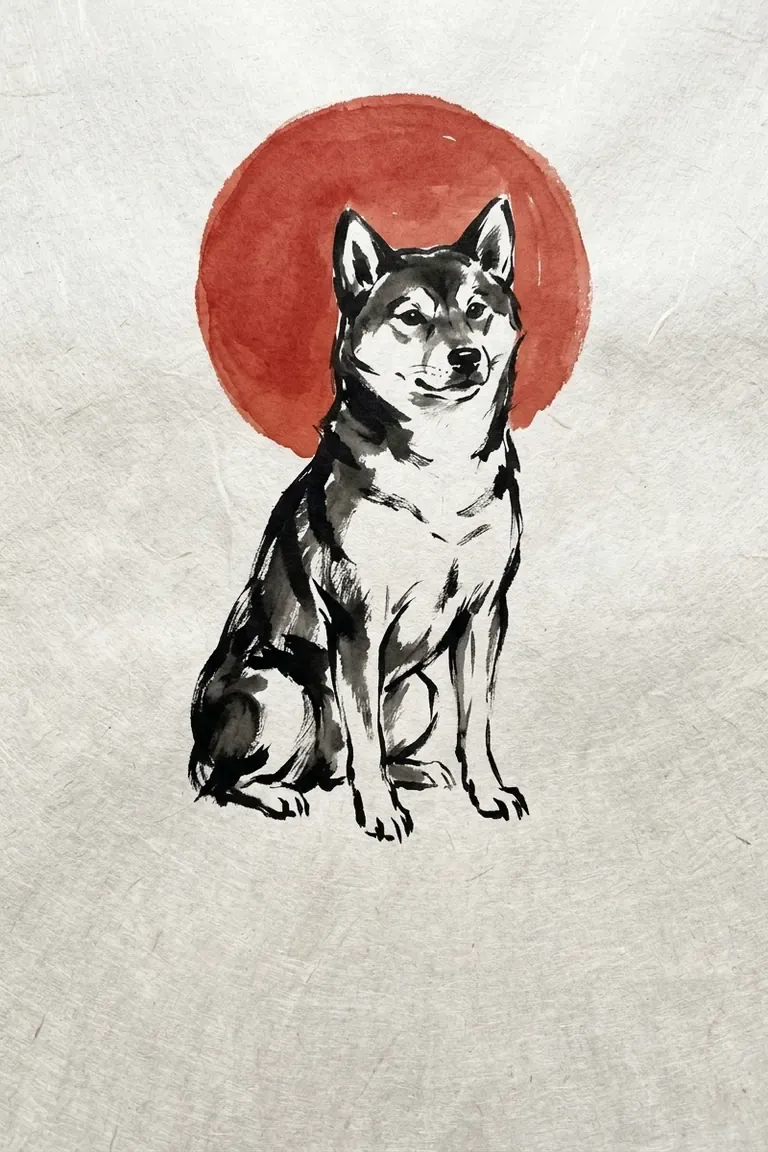
The Dog’s place in the cycle
A page on chinaculture.org says the Dog “follows Rooster as eleventh in the twelve Animal Years of the Chinese zodiac.” The Cleveland Museum of Art describes the twelve-animal zodiac series, dog included, as signifying “a traditional Chinese concept of time structured in a cyclical order.”
Two legends about the Dog’s place
Wellcome Collection tells a Great Race story. In that story, the Jade Emperor summoned all the animals, and the first twelve to cross the river and reach him were put in the zodiac. In the story the dog was a strong swimmer, but it “couldn’t resist stopping to play in the river” and “almost missed out” by finishing eleventh.
The Lam Museum of Anthropology gives a different legend, in which the Jade Emperor needed to choose twelve animals as palace guards. In that telling, Dog “bit Rabbit in a fit of anger” and “was sent to the back of the line as punishment.” The page adds: “Of course, this is only a story.”
Traits people attach to the Dog
Wellcome Collection says the dog “has the reputation of being loyal and enthusiastic,” and that people born in the Year of the Dog “are said to share the dog’s playful enthusiasm and loyalty” but “can also be stubborn.” A page on chinaculture.org says people born in that year are “very strong-willed” and “extremely loyal in friendship and love.” A National Museums Liverpool page, where Billy Hui explains the animals, calls the Dog “very generous but can be stubborn and selfish at the same time.”
A V&A blog post by Ming Wilson takes the Rabbit as its example. Saying that someone born in the Year of the Rabbit “would be of such and such a character” is, Wilson writes, “a fairly recent development,” and “There is no mention of such a belief in old Chinese texts.”
The Dog and the moon
Wellcome Collection says that in Chinese mythology a dog is responsible for the solar eclipse. “Legend has it that Tiangou (the Heavenly Dog) ate the moon, but he was captured and forced to spit the moon back out.”
A page on chinaculture.org says that in ancient times an eclipse of the moon was thought to occur when Celestial Dog, “a demon who lived on the moon,” swallowed the moon. People would bang gongs and beat drums “to intimidate Celestial Dog into spitting out the moon.”
Dogs in museum collections
Wilson’s V&A post lists an earthenware dog from the Eastern Han dynasty among its examples, and says that in the Han dynasty “dogs were bred for food, like pigs and lambs.”
The Cleveland Museum of Art’s record for its set of zodiac figures gives the medium as gray earthenware with traces of slip and the origin as China, Northern Wei dynasty. The museum says that using the twelve zodiac animals as tomb furniture “suggests they provided a cosmological structure for the afterlife.”
Every Dog year, 1900 to 2100
Each row is one lunar year of the Dog, from its lunar new year to the day before the next one. The element comes from the stem of the year.
| Year | Stem-branch | Element | Yin or yang | Starts | Ends |
|---|---|---|---|---|---|
| 1910 | Geng-xu 庚戌 | Metal | yang | 10 February 1910 | 29 January 1911 |
| 1922 | Ren-xu 壬戌 | Water | yang | 28 January 1922 | 15 February 1923 |
| 1934 | Jia-xu 甲戌 | Wood | yang | 14 February 1934 | 3 February 1935 |
| 1946 | Bing-xu 丙戌 | Fire | yang | 2 February 1946 | 21 January 1947 |
| 1958 | Wu-xu 戊戌 | Earth | yang | 18 February 1958 | 7 February 1959 |
| 1970 | Geng-xu 庚戌 | Metal | yang | 6 February 1970 | 26 January 1971 |
| 1982 | Ren-xu 壬戌 | Water | yang | 25 January 1982 | 12 February 1983 |
| 1994 | Jia-xu 甲戌 | Wood | yang | 10 February 1994 | 30 January 1995 |
| 2006 | Bing-xu 丙戌 | Fire | yang | 29 January 2006 | 17 February 2007 |
| 2018 | Wu-xu 戊戌 | Earth | yang | 16 February 2018 | 4 February 2019 |
| 2030 | Geng-xu 庚戌 | Metal | yang | 3 February 2030 | 22 January 2031 |
| 2042 | Ren-xu 壬戌 | Water | yang | 22 January 2042 | 9 February 2043 |
| 2054 | Jia-xu 甲戌 | Wood | yang | 8 February 2054 | 27 January 2055 |
| 2066 | Bing-xu 丙戌 | Fire | yang | 26 January 2066 | 13 February 2067 |
| 2078 | Wu-xu 戊戌 | Earth | yang | 12 February 2078 | 1 February 2079 |
| 2090 | Geng-xu 庚戌 | Metal | yang | 30 January 2090 | 17 February 2091 |
Sources
- The year of the dog (Wellcome Collection)
- The 12 zodiac animals at the V&A (V&A)
- Mortuary Figures of the Zodiac Signs (Cleveland Museum of Art)
- The Chinese Zodiac (Timothy S. Y. Lam Museum of Anthropology)
- The animals of the Chinese calendar (National Museums Liverpool)
- Chinese Zodiac