
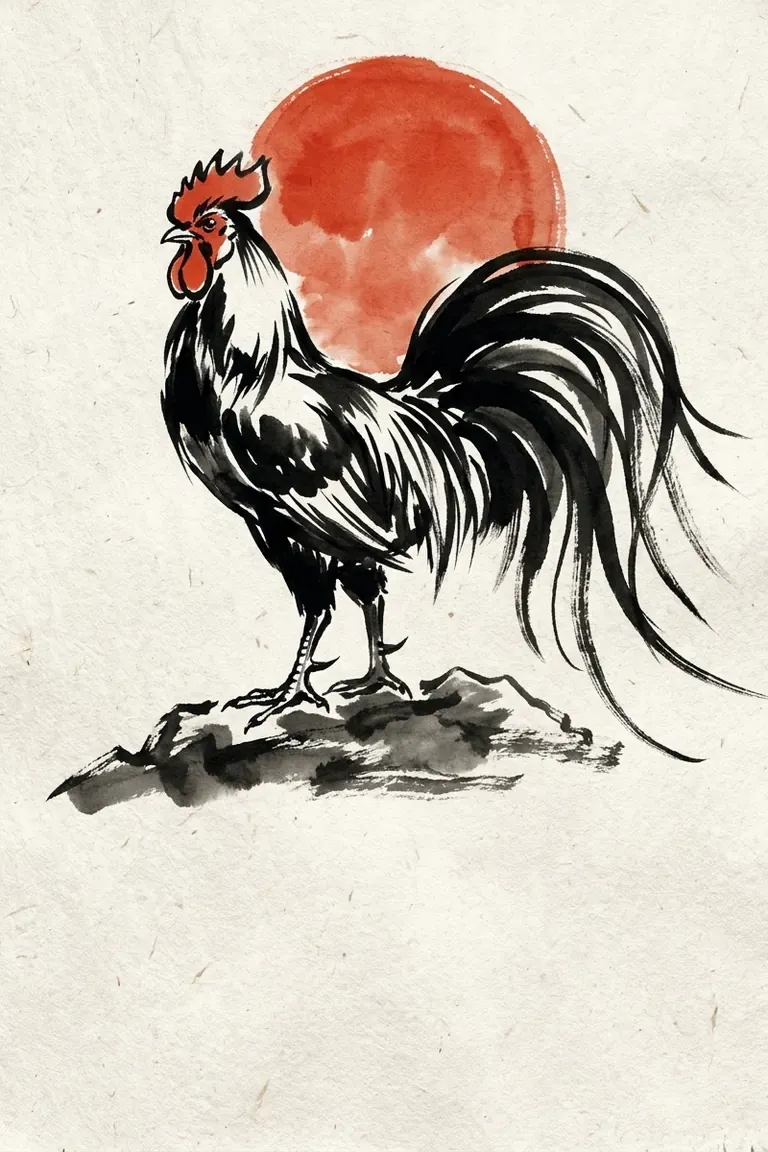
Its place in the zodiac
A page on chinaculture.org calls the Rooster “the tenth of the twelve Animal Years” and the only domestic fowl in the Chinese zodiac. The same page says that in agricultural societies the rooster has the important task of announcing the dawn.
A legend about the sun
A page on China.org.cn, by Zhou Jing, says that according to legend there were ten suns in the sky and a hero shot down nine of them, leaving only one that dared not rise. The legend goes on that a rooster was sent to call for the sun’s rise every morning, and that it was later voted one of the twelve zodiac animals.
What the rooster stands for
The National Palace Museum’s exhibition text points to word associations. In Chinese, it says, the character for “chicken” is “ji,” a homonym for “fortune,” and the chicken’s crest stands for “official” and its call for “fame.” As a result, it says, the ancients often considered the chicken an auspicious animal. It adds that the rooster was venerated as the “Bird of Virtues” for possessing civil talent, military skill, courage, benevolence and fidelity.
The China.org.cn page says the rooster traditionally symbolizes integrity, honesty, diligence and bravery.
Sayings and a custom
The same chinaculture.org page tells of Zu Ti and Liu Kun, two good friends in an Eastern Jin Dynasty story, who often urged each other to rise at cockcrow to practice sword dancing. The page says the phrase “Getting up to dance at cockcrow” later came to describe people of high ideals who do not delay in striving for self-improvement.
The page also says that in the past, a letter to be delivered at top speed customarily had up to three chicken feathers attached to the envelope, and urgent missives came to be known as “chicken feather letters.”
Chicken art and objects
For a special exhibition, the National Palace Museum selected seventeen works in its collection on the subject of chickens, paintings and one silk textile. Its text describes an anonymous Song dynasty hanging scroll, Hen and Chicks, that shows a hen leading five chicks as they peck for food, and says the subject alludes to the expression “May your five sons succeed in the civil service examinations.”
Of the exhibition’s Rooster by Xu Beihong, the museum notes that Japan had invaded China at the time it was painted, and says the artist was probably alluding to the expression “In the storm (of war), the rooster’s call (to attention) never ceases.”
A V&A blog post by Ming Wilson describes an earthenware cockerel from the Eastern Han dynasty. Wilson writes that the cockerel was a common domestic animal, and that models of it were often buried with a deceased person during the Han dynasty so that the person could continue to live in the same way as while alive.
Every Rooster year, 1900 to 2100
Each row is one lunar year of the Rooster, from its lunar new year to the day before the next one. The element comes from the stem of the year.
| Year | Stem-branch | Element | Yin or yang | Starts | Ends |
|---|---|---|---|---|---|
| 1909 | Ji-you 己酉 | Earth | yin | 22 January 1909 | 9 February 1910 |
| 1921 | Xin-you 辛酉 | Metal | yin | 8 February 1921 | 27 January 1922 |
| 1933 | Gui-you 癸酉 | Water | yin | 26 January 1933 | 13 February 1934 |
| 1945 | Yi-you 乙酉 | Wood | yin | 13 February 1945 | 1 February 1946 |
| 1957 | Ding-you 丁酉 | Fire | yin | 31 January 1957 | 17 February 1958 |
| 1969 | Ji-you 己酉 | Earth | yin | 17 February 1969 | 5 February 1970 |
| 1981 | Xin-you 辛酉 | Metal | yin | 5 February 1981 | 24 January 1982 |
| 1993 | Gui-you 癸酉 | Water | yin | 23 January 1993 | 9 February 1994 |
| 2005 | Yi-you 乙酉 | Wood | yin | 9 February 2005 | 28 January 2006 |
| 2017 | Ding-you 丁酉 | Fire | yin | 28 January 2017 | 15 February 2018 |
| 2029 | Ji-you 己酉 | Earth | yin | 13 February 2029 | 2 February 2030 |
| 2041 | Xin-you 辛酉 | Metal | yin | 1 February 2041 | 21 January 2042 |
| 2053 | Gui-you 癸酉 | Water | yin | 19 February 2053 | 7 February 2054 |
| 2065 | Yi-you 乙酉 | Wood | yin | 5 February 2065 | 25 January 2066 |
| 2077 | Ding-you 丁酉 | Fire | yin | 24 January 2077 | 11 February 2078 |
| 2089 | Ji-you 己酉 | Earth | yin | 10 February 2089 | 29 January 2090 |