
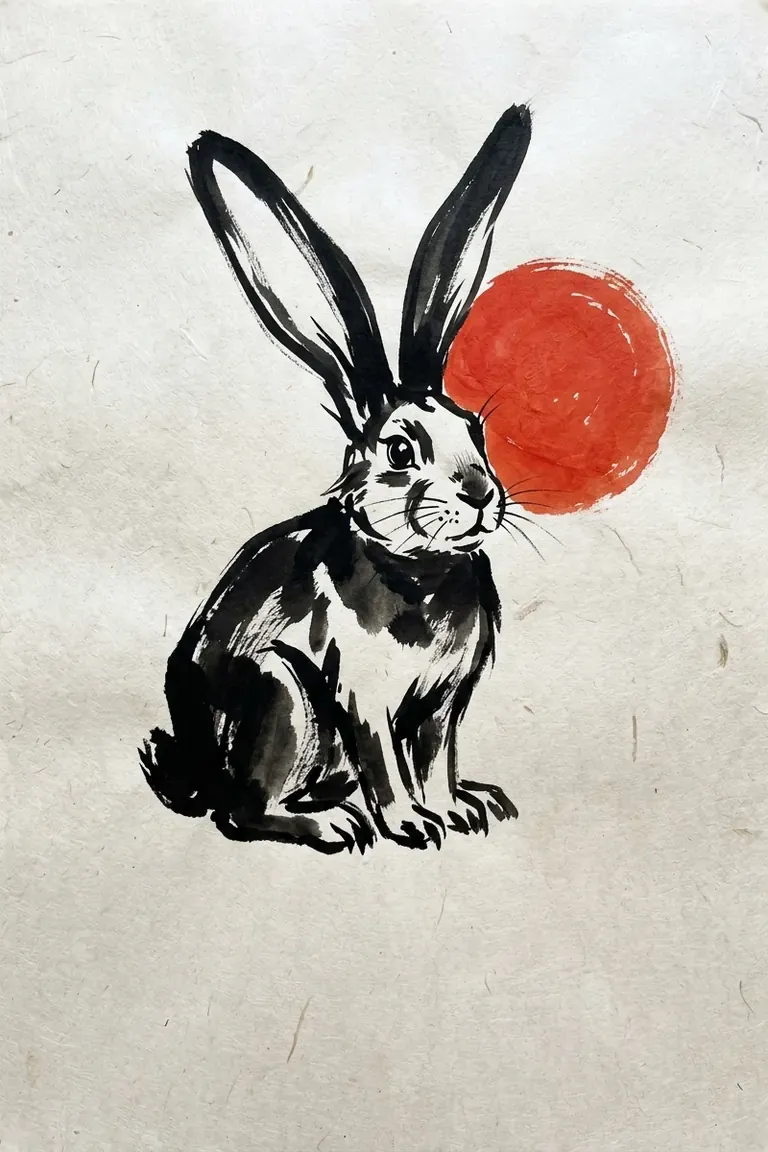
Fourth in the cycle
The Lam Museum lists the twelve animals in order as Rat, Ox, Tiger, Rabbit, and a page on chinaculture.org says the Rabbit comes fourth. The National Palace Museum writes that the twelve earthly branches correspond to twelve animals, and that the branch mao matches the rabbit. China Daily adds that mao means the time between 5 am and 7 am.
A V&A blog post by Ming Wilson speaks of the Year of the Rabbit and adds that some say Hare.
One legend of the twelve animals
One legend, retold by the Lam Museum, says the Jade Emperor needed twelve animals as palace guards. Rat jumped in front of Ox in the line. Tiger and Dragon thought that was unfair, and so did Rabbit, who challenged Dragon to a race, won, and moved up closer to the front. The page adds: “Of course, this is only a story.”
The Jade Rabbit and the moon
According to Wilson, legend has it that the living things on the moon are Chang’e, a man called Wu Gang and a rabbit that pounds the elixir of immortality, so the rabbit is often associated with the moon. The post’s entry for the Rabbit shows a detail of an emperor’s summer court robe with the moon.
The chinaculture.org page says that in traditional Chinese culture Jade Rabbit is another name for the moon. The National Palace Museum, which says both rabbit and hare, mentions “the hare accompanying Chang’e”.
Symbols and art
The National Palace Museum says rabbits were regarded as auspicious symbols in ancient China. It cites a Tang dynasty text that judges a rabbit’s auspiciousness by fur color: “red rabbits are the most propitious; white rabbits are moderately propitious.” One painting on its page, Rabbit Reclining Beside a Tall Pine by the Qing court painter Yang Dazhang, shows a rabbit curled up behind a boulder to avoid the cold.
The chinaculture.org page says people love rabbits for their cleverness, agility and charm. China Daily cites Han dynasty tomb portraits called “jade rabbits pounding medicine”, some of which add a pair of wings to the rabbits.
Character, and how old the idea is
National Museums Liverpool describes the Rabbit as the luckiest of all signs in the Chinese calendar, talented and articulate, affectionate yet shy, and a sign that seeks peace throughout life. Wilson writes that saying someone born in the Year of the Rabbit would be of such and such a character is a fairly recent development, and that there is no mention of such a belief in old Chinese texts.
Every Rabbit year, 1900 to 2100
Each row is one lunar year of the Rabbit, from its lunar new year to the day before the next one. The element comes from the stem of the year.
| Year | Stem-branch | Element | Yin or yang | Starts | Ends |
|---|---|---|---|---|---|
| 1903 | Gui-mao 癸卯 | Water | yin | 29 January 1903 | 15 February 1904 |
| 1915 | Yi-mao 乙卯 | Wood | yin | 14 February 1915 | 2 February 1916 |
| 1927 | Ding-mao 丁卯 | Fire | yin | 2 February 1927 | 22 January 1928 |
| 1939 | Ji-mao 己卯 | Earth | yin | 19 February 1939 | 7 February 1940 |
| 1951 | Xin-mao 辛卯 | Metal | yin | 6 February 1951 | 26 January 1952 |
| 1963 | Gui-mao 癸卯 | Water | yin | 25 January 1963 | 12 February 1964 |
| 1975 | Yi-mao 乙卯 | Wood | yin | 11 February 1975 | 30 January 1976 |
| 1987 | Ding-mao 丁卯 | Fire | yin | 29 January 1987 | 16 February 1988 |
| 1999 | Ji-mao 己卯 | Earth | yin | 16 February 1999 | 4 February 2000 |
| 2011 | Xin-mao 辛卯 | Metal | yin | 3 February 2011 | 22 January 2012 |
| 2023 | Gui-mao 癸卯 | Water | yin | 22 January 2023 | 9 February 2024 |
| 2035 | Yi-mao 乙卯 | Wood | yin | 8 February 2035 | 27 January 2036 |
| 2047 | Ding-mao 丁卯 | Fire | yin | 26 January 2047 | 13 February 2048 |
| 2059 | Ji-mao 己卯 | Earth | yin | 12 February 2059 | 1 February 2060 |
| 2071 | Xin-mao 辛卯 | Metal | yin | 31 January 2071 | 18 February 2072 |
| 2083 | Gui-mao 癸卯 | Water | yin | 17 February 2083 | 5 February 2084 |
| 2095 | Yi-mao 乙卯 | Wood | yin | 5 February 2095 | 24 January 2096 |
Sources
- The 12 zodiac animals at the V&A (V&A)
- Current exhibition - National Palace Museum (National Palace Museum)
- YEAR OF THE RABBIT SEES MUCH-LOVED CREATURE HOP ONTO CENTER STAGE (China Daily)
- The Chinese Zodiac (Timothy S. Y. Lam Museum of Anthropology)
- The animals of the Chinese calendar (National Museums Liverpool)
- Chinese Zodiac