
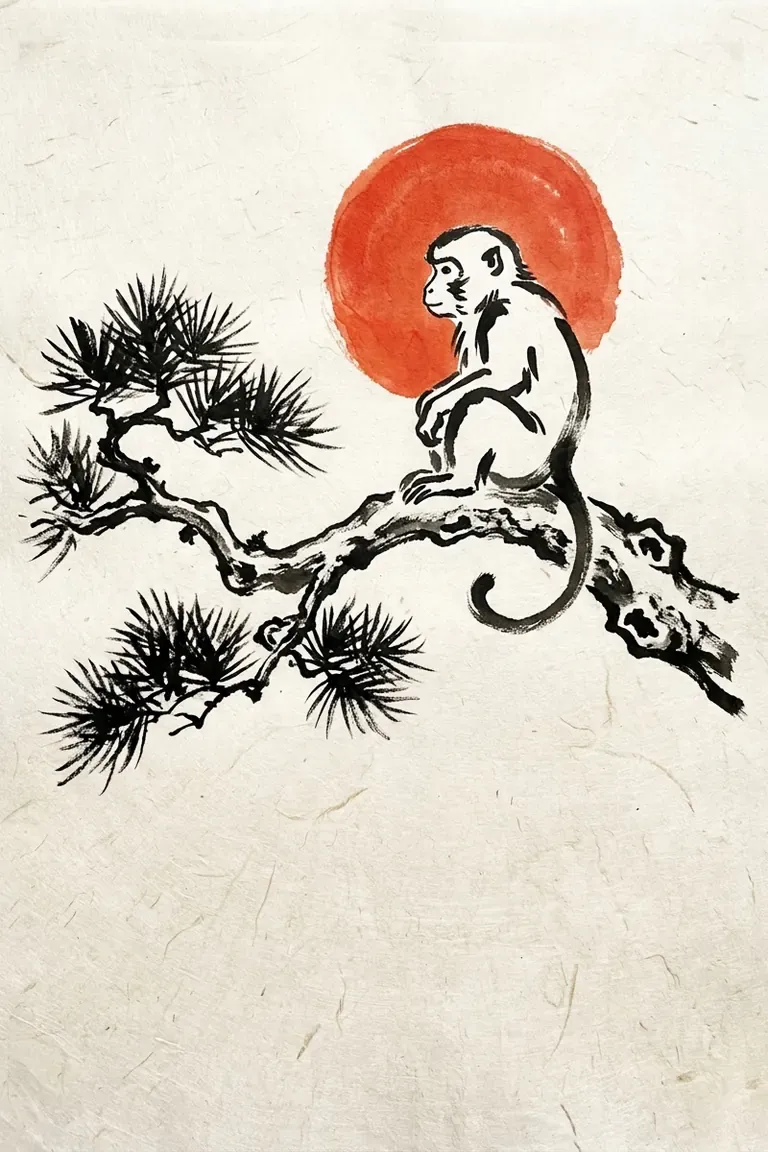
The Monkey’s place in the cycle
A page on chinaculture.org says that although the Monkey is ninth in the Chinese zodiac, it is first in terms of wit and agility. The page also calls the Monkey the cleverest of the twelve animals.
An Ashmolean Museum blog post says people born in the Year of the Monkey are thought to be lively, intelligent, sociable and at times self-centered. The chinaculture.org page describes them as brave and resourceful, energetic and competitive, and adds that they can be quite capricious.
The Monkey in legend
A China.org.cn article by Zhou Jing says folktales tell of a lonely tiger, known as the “King of the Mountain.” In these folktales, the monkey, its neighbor, was the only animal brave enough to speak to it, and came to its rescue when it fell into a trap. In the same folktales, when the selection of the twelve zodiac animals began, the tiger voted for the monkey because of its wit and wisdom.
A page from the Timothy S. Y. Lam Museum of Anthropology gives another legend, in which the Jade Emperor needed to choose twelve animals as palace guards. The Snake, Horse, Goat, Monkey and Rooster fought amongst themselves, and the page adds that this is only a story.
Sun Wukong and the Monkey King
The Ashmolean post says the Monkey King, also called Sun Wukong, is the main character in the famous Chinese novel Journey to the West. After being cast out of heaven, it says, he redeems himself by helping the Tang dynasty monk Xuanzang on his pilgrimage to India. A V&A blog post by Ming Wilson says one of the monk’s disciples was a monkey, who protected him from the many perils during the journey.
The chinaculture.org page says Sun Wukong can leap 108,000 li in a single bound and transform himself into 72 different forms, and calls him a beloved folk hero of the Chinese people. The Ashmolean post adds that the Monkey King is a very popular character in Beijing opera.
Monkey art and objects in two museum blogs
The Ashmolean post describes an exhibition in 2016, drawn from the museum’s collections of Asian art, that celebrated the Year of the Monkey with images of monkeys from across Asia. The post also describes a color woodblock print from Japan by Tsukioka Yoshitoshi that frames the Monkey King against an enormous moon, with the Jade Rabbit in the background. The post says that, as there is no myth that involves the two characters together, it seems to be Yoshitoshi’s idea to bring them together.
Wilson’s V&A post lists an agate piece under its Monkey heading.
Every Monkey year, 1900 to 2100
Each row is one lunar year of the Monkey, from its lunar new year to the day before the next one. The element comes from the stem of the year.
| Year | Stem-branch | Element | Yin or yang | Starts | Ends |
|---|---|---|---|---|---|
| 1908 | Wu-shen 戊申 | Earth | yang | 2 February 1908 | 21 January 1909 |
| 1920 | Geng-shen 庚申 | Metal | yang | 20 February 1920 | 7 February 1921 |
| 1932 | Ren-shen 壬申 | Water | yang | 6 February 1932 | 25 January 1933 |
| 1944 | Jia-shen 甲申 | Wood | yang | 25 January 1944 | 12 February 1945 |
| 1956 | Bing-shen 丙申 | Fire | yang | 12 February 1956 | 30 January 1957 |
| 1968 | Wu-shen 戊申 | Earth | yang | 30 January 1968 | 16 February 1969 |
| 1980 | Geng-shen 庚申 | Metal | yang | 16 February 1980 | 4 February 1981 |
| 1992 | Ren-shen 壬申 | Water | yang | 4 February 1992 | 22 January 1993 |
| 2004 | Jia-shen 甲申 | Wood | yang | 22 January 2004 | 8 February 2005 |
| 2016 | Bing-shen 丙申 | Fire | yang | 8 February 2016 | 27 January 2017 |
| 2028 | Wu-shen 戊申 | Earth | yang | 26 January 2028 | 12 February 2029 |
| 2040 | Geng-shen 庚申 | Metal | yang | 12 February 2040 | 31 January 2041 |
| 2052 | Ren-shen 壬申 | Water | yang | 1 February 2052 | 18 February 2053 |
| 2064 | Jia-shen 甲申 | Wood | yang | 17 February 2064 | 4 February 2065 |
| 2076 | Bing-shen 丙申 | Fire | yang | 5 February 2076 | 23 January 2077 |
| 2088 | Wu-shen 戊申 | Earth | yang | 24 January 2088 | 9 February 2089 |
| 2100 | Geng-shen 庚申 | Metal | yang | 9 February 2100 | 28 January 2101 |
Sources
- Monkey Tales: Apes and Monkeys in Asian Art (Ashmolean Museum)
- The 12 zodiac animals at the V&A (V&A)
- The Chinese Zodiac (Timothy S. Y. Lam Museum of Anthropology)
- Chinese Zodiac
- Chinese zodiac animals: The monkey and what it represents (China.org.cn)