
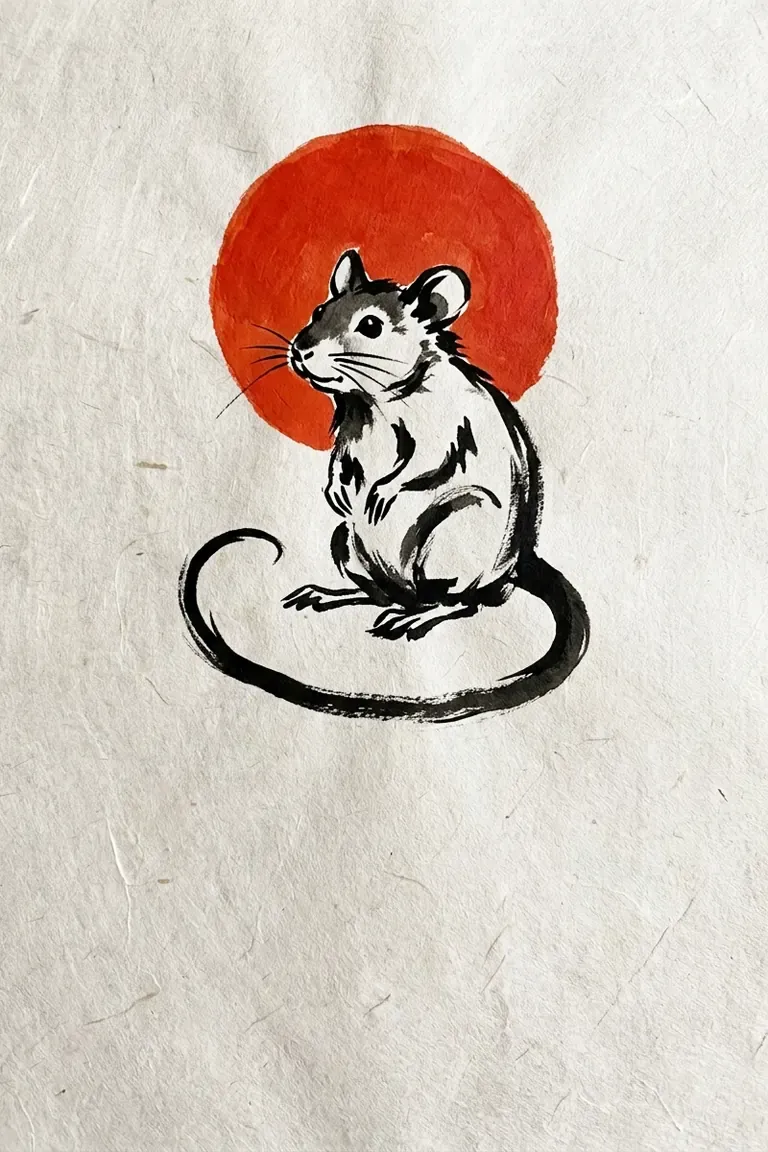
First of the twelve
The Timothy S. Y. Lam Museum of Anthropology gives the order of the twelve zodiac animals as Rat, Ox, Tiger and so on to Pig. The Rat comes first.
A page on chinaculture.org says each of the twelve animals was linked to one of the twelve Earthly Branches, and that the Rat corresponded to zi, the first Earthly Branch.
In a V&A blog post, Ming Wilson writes that a year was reckoned from a heavenly stem and an earthly branch, and that the cycle repeated every sixty years. Wilson adds that pairing an animal with each earthly branch dates back to very old times.
The race, told as a legend
The National Palace Museum says that, according to legend, the Jade Emperor held a contest of the zodiac animals and ranked them by their placement in the race. In the story it singles out, the rat could not wake a sleeping cat and chose an ox as its partner instead. Just before the finish line the rat jumped off the ox’s back and came in first, and the angry cat became its enemy.
The Lam Museum tells another legend. The Jade Emperor must choose twelve animals as palace guards, the Cat asks his neighbor Rat to help him sign up, and Rat forgets. At the palace Ox is first in line, but Rat secretly climbs onto Ox’s back and jumps in front of him. The museum adds that this is only a story.
National Museums Liverpool, in a page where Billy Hui explains the animals, says the story of the twelve animals originates from an ancient Chinese poem, that they appeared in an order starting with the Rat, and that in much later years this led to the tale of the animals racing each other.
What the sources say about its character
The Liverpool page describes the Rat as ambitious and honest, and prone to spending freely.
Ming Wilson’s V&A post, using the Year of the Rabbit as its example, says that describing someone born in that year as having a particular character is a fairly recent development, and that old Chinese texts do not mention such a belief.
The Rat in museum collections
The same V&A post says the rat was seldom used as a decorative motif on old Chinese artefacts. The example it shows is modern: a teapot and cup with a rat design, made in Jingdezhen.
The Cleveland Museum of Art has earthenware mortuary figures of the zodiac animals from China’s Northern Wei dynasty. Its description lists the twelve-animal series, rat first, and says the series signifies a traditional Chinese concept of time structured in a cyclical order, and says using the animals as tomb furniture suggests they provided a cosmological structure for the afterlife.
Every Rat year, 1900 to 2100
Each row is one lunar year of the Rat, from its lunar new year to the day before the next one. The element comes from the stem of the year.
| Year | Stem-branch | Element | Yin or yang | Starts | Ends |
|---|---|---|---|---|---|
| 1900 | Geng-zi 庚子 | Metal | yang | 31 January 1900 | 18 February 1901 |
| 1912 | Ren-zi 壬子 | Water | yang | 18 February 1912 | 5 February 1913 |
| 1924 | Jia-zi 甲子 | Wood | yang | 5 February 1924 | 23 January 1925 |
| 1936 | Bing-zi 丙子 | Fire | yang | 24 January 1936 | 10 February 1937 |
| 1948 | Wu-zi 戊子 | Earth | yang | 10 February 1948 | 28 January 1949 |
| 1960 | Geng-zi 庚子 | Metal | yang | 28 January 1960 | 14 February 1961 |
| 1972 | Ren-zi 壬子 | Water | yang | 15 February 1972 | 2 February 1973 |
| 1984 | Jia-zi 甲子 | Wood | yang | 2 February 1984 | 19 February 1985 |
| 1996 | Bing-zi 丙子 | Fire | yang | 19 February 1996 | 6 February 1997 |
| 2008 | Wu-zi 戊子 | Earth | yang | 7 February 2008 | 25 January 2009 |
| 2020 | Geng-zi 庚子 | Metal | yang | 25 January 2020 | 11 February 2021 |
| 2032 | Ren-zi 壬子 | Water | yang | 11 February 2032 | 30 January 2033 |
| 2044 | Jia-zi 甲子 | Wood | yang | 30 January 2044 | 16 February 2045 |
| 2056 | Bing-zi 丙子 | Fire | yang | 15 February 2056 | 3 February 2057 |
| 2068 | Wu-zi 戊子 | Earth | yang | 3 February 2068 | 22 January 2069 |
| 2080 | Geng-zi 庚子 | Metal | yang | 22 January 2080 | 8 February 2081 |
| 2092 | Ren-zi 壬子 | Water | yang | 7 February 2092 | 26 January 2093 |
Sources
- The 12 zodiac animals at the V&A (V&A)
- Animals of the Chinese Zodiac (National Palace Museum)
- The Chinese Zodiac (Timothy S. Y. Lam Museum of Anthropology)
- Chinese Zodiac
- The animals of the Chinese calendar (National Museums Liverpool)
- Mortuary Figures of the Zodiac Signs (Cleveland Museum of Art)