
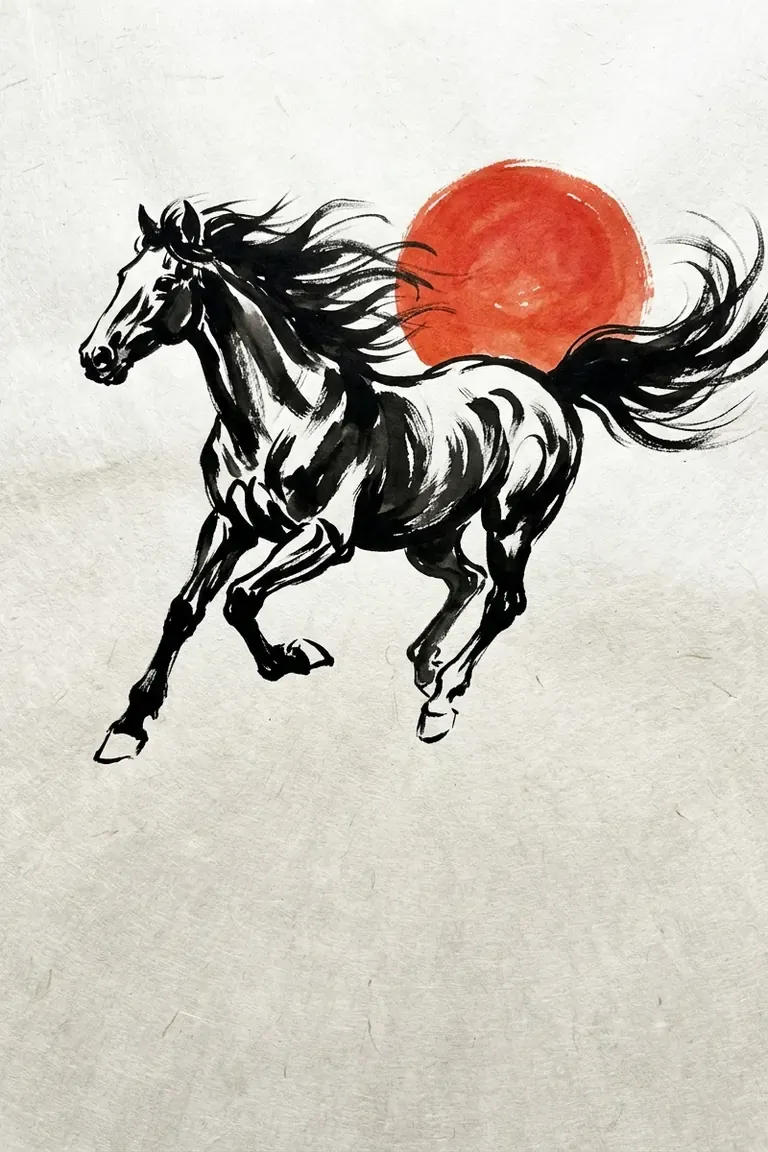
Where the Horse sits in the cycle
The Horse is the seventh of the twelve animals of the Chinese zodiac, according to a page on chinaculture.org and to a Cincinnati Art Museum blog post by Eric Hughett.
The Key Concepts in Chinese Thought and Culture site says the twelve animals were associated with the twelve Earthly Branches, each representing a year. Its combined list gives wuma (午马) for the horse.
A legend about the horse
A China.org.cn article by Zhou Jing retells a legend. In ancient times, it says, the horse had wings and lived among the immortals in the Heavenly Palace. It could run, fly and swim, but its arrogance caused many troubles. As punishment, the Jade Emperor removed its wings and imprisoned it under Kunlun Mountain for 300 years.
In the legend, humans later helped the horse escape. In gratitude, it worked the land, pulled carts, carried materials and served in wartime. As a result, the article says, the horse was selected as one of the twelve zodiac animals.
What the Horse stands for
A LACMA post by Katie Booth calls the horse one of the most dynamic symbols in Chinese culture, long associated with strength, success and forward motion. The China.org.cn article says that in traditional Chinese culture the horse symbolizes strength, speed, bravery, loyalty, freedom and talent.
The same chinaculture.org page says the image of a spirited horse running free symbolizes ease and success, and that the saying “One horse leads the herd” describes great initiative.
A post by the Smithsonian’s National Museum of Asian Art reports that people born in the Year of the Horse are said to be intelligent, strong and energetic, with an outgoing nature.
The horse in Chinese art and history
The Cincinnati Art Museum post says the horse has been associated with heaven and its endless creative energy and strength since the twelfth century BCE, and that this link with the divine made horses a potent symbol for imperial power. The earliest horse art, it says, comes from imperial and aristocratic sources, such as a Tang dynasty ceramic horse that was a high-status burial good. The post also describes a Ming dynasty jade horse with precious stone inlaid eyes, nearly 12 inches in height, that would have been incredibly costly.
The Smithsonian post says that, according to archaeological discoveries, the character for horse (ma) appears in the most ancient form of Chinese writing. It adds that Han dynasty traders imported the highly coveted “heavenly horses” (tianma) from the Central Asian kingdom of Ferghana.
LACMA’s post adds that across centuries, artists returned to the horse to express freedom, vitality and hope for what lies ahead.
Every Horse year, 1900 to 2100
Each row is one lunar year of the Horse, from its lunar new year to the day before the next one. The element comes from the stem of the year.
| Year | Stem-branch | Element | Yin or yang | Starts | Ends |
|---|---|---|---|---|---|
| 1906 | Bing-wu 丙午 | Fire | yang | 25 January 1906 | 12 February 1907 |
| 1918 | Wu-wu 戊午 | Earth | yang | 11 February 1918 | 31 January 1919 |
| 1930 | Geng-wu 庚午 | Metal | yang | 30 January 1930 | 16 February 1931 |
| 1942 | Ren-wu 壬午 | Water | yang | 15 February 1942 | 4 February 1943 |
| 1954 | Jia-wu 甲午 | Wood | yang | 3 February 1954 | 23 January 1955 |
| 1966 | Bing-wu 丙午 | Fire | yang | 21 January 1966 | 8 February 1967 |
| 1978 | Wu-wu 戊午 | Earth | yang | 7 February 1978 | 27 January 1979 |
| 1990 | Geng-wu 庚午 | Metal | yang | 27 January 1990 | 14 February 1991 |
| 2002 | Ren-wu 壬午 | Water | yang | 12 February 2002 | 31 January 2003 |
| 2014 | Jia-wu 甲午 | Wood | yang | 31 January 2014 | 18 February 2015 |
| 2026 | Bing-wu 丙午 | Fire | yang | 17 February 2026 | 5 February 2027 |
| 2038 | Wu-wu 戊午 | Earth | yang | 4 February 2038 | 23 January 2039 |
| 2050 | Geng-wu 庚午 | Metal | yang | 23 January 2050 | 10 February 2051 |
| 2062 | Ren-wu 壬午 | Water | yang | 9 February 2062 | 28 January 2063 |
| 2074 | Jia-wu 甲午 | Wood | yang | 27 January 2074 | 14 February 2075 |
| 2086 | Bing-wu 丙午 | Fire | yang | 14 February 2086 | 2 February 2087 |
| 2098 | Wu-wu 戊午 | Earth | yang | 1 February 2098 | 20 January 2099 |
Sources
- Happy Year of the Horse! (Cincinnati Art Museum)
- Galloping into the Year of the Horse (Los Angeles County Museum of Art)
- Happy New Year of the Horse! (Smithsonian's National Museum of Asian Art)
- Chinese zodiac animals: The horse and what it represents (China.org.cn)
- Chinese Zodiac
- The Chinese Zodiac / Animal of the Year (Foreign Language Teaching and Research Press Co.,Ltd.)