
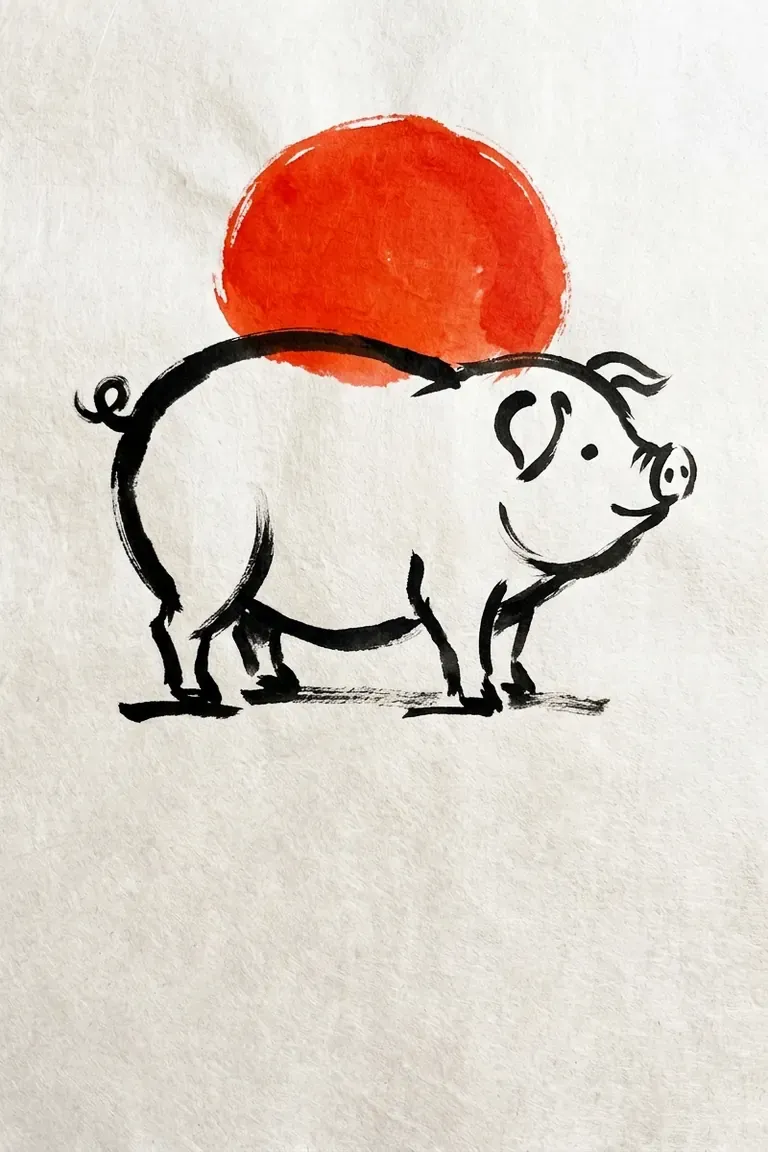
Where the pig sits in the cycle
World History Encyclopedia calls the pig the twelfth animal of the Chinese zodiac. A post on The Bowes Museum Blog says the pig had the twelfth year named after it as a reward for finishing the race, “or so the legend says.”
The Cleveland Museum of Art describes a twelve-animal zodiac series of earthenware mortuary figures, and the list it gives names a boar and never uses the word pig.
Legends about the pig’s place
The Bowes post ties the pig to the Great Race set by the Jade Emperor: it came last because it stopped for food and a nap. World History Encyclopedia tells the Great Race too and calls it the better known of two stories. In its telling, the pig says it was hungry, stopped for snacks and took a nap after eating, and the Jade Emperor welcomes it to the zodiac.
In the article’s other story, the Jade Emperor turns a person who was lazy and self-indulgent all their life into a pig. An officer misunderstands the order to send it back to earth and places it in the sky, and so the pig becomes the last sign.
A page on China.org.cn gives a separate legend, in which Emperor Xuanyuan decides the order. The pig, aware of its clumsy body and slow speed, rose early and faced numerous hardships to reach the Heavenly Palace, only to find the ranking already concluded. Impressed by its determination, the emperor assigned it the last position.
What the tradition says about the pig
The China.org.cn page says that in traditional Chinese culture the pig symbolizes wealth, abundance and good fortune. World History Encyclopedia says pigs symbolize good fortune and happiness as they seem to live a care-free existence.
People born in the Year of the Pig are expected to be sincere, honest, diligent, generous and open-minded, according to China.org.cn. The Bowes post says the pig’s characteristics are said to be conscientiousness, generosity, calm and compassion, though it can also be gullible and quiet.
World History Encyclopedia adds that the pig is not always featured positively. It also symbolized sloth, self-indulgence, intemperance and lack of self-control.
Pigs in objects and art
A V&A blog post by Ming Wilson lists a jade pig of the Han dynasty among its examples. Some models of pigs are made of jade rather than pottery, the post says, and the style is known as the “Han eight cut”, meaning the craftsman made minimal use of the carving knife.
More broadly, the Bowes post says the pig did not get as much “canvas” time as other animals in the history of arts, and that when it is depicted it is usually associated with farm and everyday peasant life.
Every Pig year, 1900 to 2100
Each row is one lunar year of the Pig, from its lunar new year to the day before the next one. The element comes from the stem of the year.
| Year | Stem-branch | Element | Yin or yang | Starts | Ends |
|---|---|---|---|---|---|
| 1911 | Xin-hai 辛亥 | Metal | yin | 30 January 1911 | 17 February 1912 |
| 1923 | Gui-hai 癸亥 | Water | yin | 16 February 1923 | 4 February 1924 |
| 1935 | Yi-hai 乙亥 | Wood | yin | 4 February 1935 | 23 January 1936 |
| 1947 | Ding-hai 丁亥 | Fire | yin | 22 January 1947 | 9 February 1948 |
| 1959 | Ji-hai 己亥 | Earth | yin | 8 February 1959 | 27 January 1960 |
| 1971 | Xin-hai 辛亥 | Metal | yin | 27 January 1971 | 14 February 1972 |
| 1983 | Gui-hai 癸亥 | Water | yin | 13 February 1983 | 1 February 1984 |
| 1995 | Yi-hai 乙亥 | Wood | yin | 31 January 1995 | 18 February 1996 |
| 2007 | Ding-hai 丁亥 | Fire | yin | 18 February 2007 | 6 February 2008 |
| 2019 | Ji-hai 己亥 | Earth | yin | 5 February 2019 | 24 January 2020 |
| 2031 | Xin-hai 辛亥 | Metal | yin | 23 January 2031 | 10 February 2032 |
| 2043 | Gui-hai 癸亥 | Water | yin | 10 February 2043 | 29 January 2044 |
| 2055 | Yi-hai 乙亥 | Wood | yin | 28 January 2055 | 14 February 2056 |
| 2067 | Ding-hai 丁亥 | Fire | yin | 14 February 2067 | 2 February 2068 |
| 2079 | Ji-hai 己亥 | Earth | yin | 2 February 2079 | 21 January 2080 |
| 2091 | Xin-hai 辛亥 | Metal | yin | 18 February 2091 | 6 February 2092 |
Sources
- This year’s star: The pig (The Bowes Museum)
- Pigs in Ancient China (World History Encyclopedia)
- Chinese zodiac animals: The pig and what it represents (China.org.cn)
- The 12 zodiac animals at the V&A (V&A)
- Mortuary Figures of the Zodiac Signs (Cleveland Museum of Art)