
What yang means
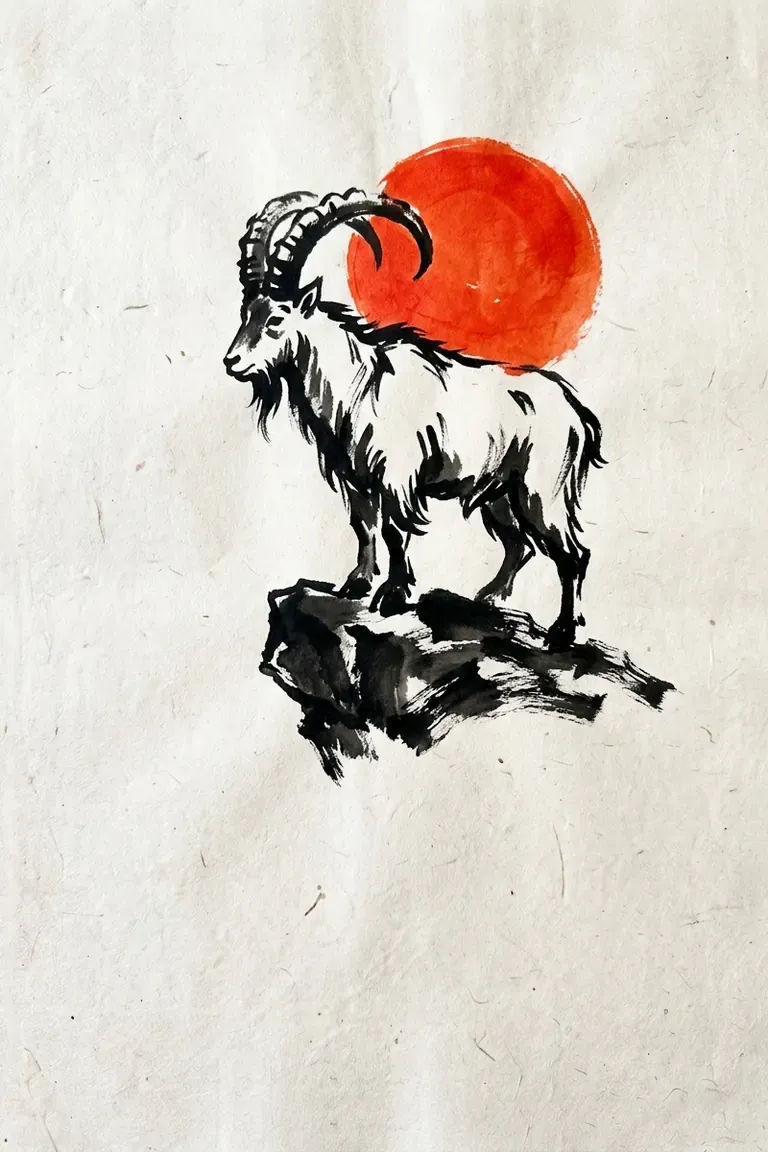
In Chinese, the animal is called yang. Colin Mackerras of Griffith University writes that the word can mean sheep, goat or even other similar horned animals, such as the gazelle. To be specific, a goat is a “mountain yang” (shanyang) and a sheep is sometimes a “cotton yang” (mianyang).
English has three names for the same year. Mackerras calls all three usages correct, and the V&A’s blog speaks of the ram. Mackerras adds that Japan reads the animal as sheep, while Vietnam identifies it as goat. This page says Goat, but its sources use all three names.
Where the Goat sits in the cycle
A chinaculture.org page on the sheep puts the animal eighth in the Chinese zodiac. Key Concepts in Chinese Thought and Culture explains that the animals were associated with the twelve earthly branches in a twelve-year cycle, each animal representing a year. Its list gives the sheep’s entry as weiyang.
Symbols tied to the word
A V&A blog post by Ming Wilson notes that the Chinese word for ram, yang, is pronounced the same as the word for sun, “hence the ram is another auspicious symbol”. Among its examples is a cloisonné ram-shaped box from the Qianlong reign.
The same chinaculture.org page, which speaks of the sheep, calls it docile and benevolent. It points out that many auspicious characters contain the component yang, among them those for kindness (shan), beauty (mei), luck (xiang) and brightness (xian). It also relays a legend of a divine sheep, xiezhi, that could recognize wrongdoers and gore them, which is why judges in the ancient state of Chu wore its image on their hats as a symbol of impartiality.
Character traits, as the sources describe them
A V&A blog post by Ming Wilson observes, using the rabbit as its example, that judging character by birth year is a fairly recent development that old Chinese texts do not mention.
A second chinaculture.org page describes people born in the Year of the Sheep as meticulous and considerate, steadfast, unafraid of hardship, and aware of the value of thrift. It also names faults: they can be self-absorbed and obstinate, and both timid and irresolute.
The Goat in painting
The Smithsonian’s National Museum of Asian Art catalogues a painting called Sheep and Goat by Zhao Mengfu, whom it names the preeminent painter and calligrapher of the early Yuan dynasty. In its description the two animals turn their heads back toward each other. In his inscription, as the museum’s label gives it, Zhao says he had painted horses before but never sheep [or goats], so when Zhongxin requested a painting he playfully drew these for him from life.
The Qianlong emperor, who once owned the scroll, also provided the title frontispiece, borrowing vocabulary from an ancient poem about sheep. It reads: “Divine likeness [of sheep] in motion and repose.”
Every Goat year, 1900 to 2100
Each row is one lunar year of the Goat, from its lunar new year to the day before the next one. The element comes from the stem of the year.
| Year | Stem-branch | Element | Yin or yang | Starts | Ends |
|---|---|---|---|---|---|
| 1907 | Ding-wei 丁未 | Fire | yin | 13 February 1907 | 1 February 1908 |
| 1919 | Ji-wei 己未 | Earth | yin | 1 February 1919 | 19 February 1920 |
| 1931 | Xin-wei 辛未 | Metal | yin | 17 February 1931 | 5 February 1932 |
| 1943 | Gui-wei 癸未 | Water | yin | 5 February 1943 | 24 January 1944 |
| 1955 | Yi-wei 乙未 | Wood | yin | 24 January 1955 | 11 February 1956 |
| 1967 | Ding-wei 丁未 | Fire | yin | 9 February 1967 | 29 January 1968 |
| 1979 | Ji-wei 己未 | Earth | yin | 28 January 1979 | 15 February 1980 |
| 1991 | Xin-wei 辛未 | Metal | yin | 15 February 1991 | 3 February 1992 |
| 2003 | Gui-wei 癸未 | Water | yin | 1 February 2003 | 21 January 2004 |
| 2015 | Yi-wei 乙未 | Wood | yin | 19 February 2015 | 7 February 2016 |
| 2027 | Ding-wei 丁未 | Fire | yin | 6 February 2027 | 25 January 2028 |
| 2039 | Ji-wei 己未 | Earth | yin | 24 January 2039 | 11 February 2040 |
| 2051 | Xin-wei 辛未 | Metal | yin | 11 February 2051 | 31 January 2052 |
| 2063 | Gui-wei 癸未 | Water | yin | 29 January 2063 | 16 February 2064 |
| 2075 | Yi-wei 乙未 | Wood | yin | 15 February 2075 | 4 February 2076 |
| 2087 | Ding-wei 丁未 | Fire | yin | 3 February 2087 | 23 January 2088 |
| 2099 | Ji-wei 己未 | Earth | yin | 21 January 2099 | 8 February 2100 |
Sources
- The 12 zodiac animals at the V&A (V&A)
- Year of the... Goat? (Griffith University)
- Chinese Zodiac
- Chinese Zodiac
- The Chinese Zodiac / Animal of the Year (Foreign Language Teaching and Research Press (Key Concepts in Chinese Thought and Culture))
- Sheep and Goat (Smithsonian's National Museum of Asian Art)