
Second in the cycle
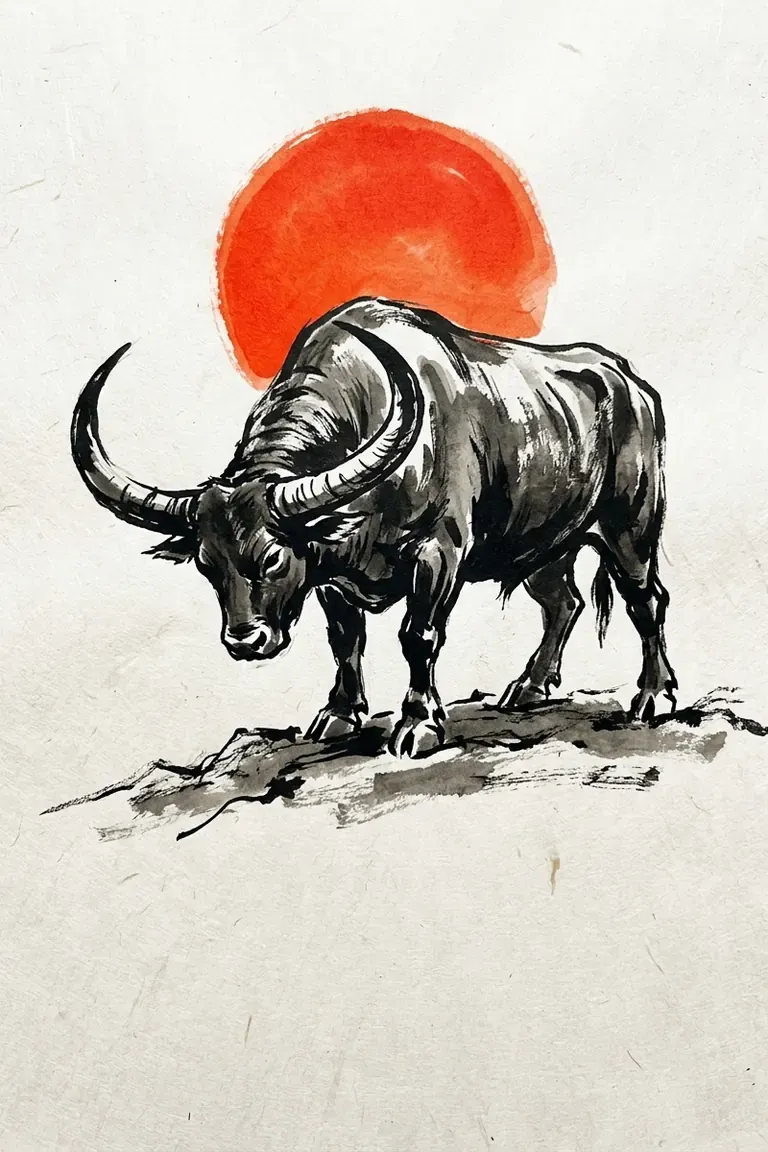
The Ox comes second among the twelve zodiac animals, after the Rat.
In a V&A blog post, Ming Wilson explains that a traditional Chinese year had two parts: a heavenly stem, of which there are ten, and an earthly branch, of which there are twelve. The cycle repeated every sixty years. A page on chinaculture.org names the Ox’s branch: Ox corresponded to chou, the second Earthly Branch.
China Daily says “ox” here is a translation of the Chinese character niu, which covers diverse breeds of the bovine group, both domestic and feral. National Geographic notes that in Vietnam the water buffalo replaces the ox.
The race legend
The National Palace Museum writes that, according to legend, the Jade Emperor held a contest of the zodiac animals. They were ranked in the order of their placement in the race, and each was assigned one of the twelve years. National Geographic adds that the race is credited to either the Buddha or the Jade Emperor.
The National Palace Museum also mentions one telling: the rat could not wake a sleeping cat and chose an ox as its partner instead. Just before the finish line the rat jumped off the ox’s back and came in first, to the anger of the cat, who became its enemy. National Geographic also reports that myths state the rat hitched a ride on the back of the next animal, the ox.
What the ox stands for
China Daily calls the ox a symbol of toil and determination, inclined to be steadfast and trustworthy. The V&A post says that to the Chinese farmer the ox was a best friend, without which the farmer would have to toil a lot more in the field.
A second page on chinaculture.org says China’s traditional agricultural society holds cattle in high esteem. It describes people born in the Year of the Ox as enterprising, cautious and sure-footed by nature, and adds that they can be bull-headed and stubborn.
The V&A post adds that, with the Rabbit as its example, saying someone born in a zodiac year has a certain character is a fairly recent development, and that old Chinese texts do not mention such a belief.
The ox in art
Wilson’s post says a boy on the back of an ox is a romanticized way to represent a diligent yet contented population going about their business in a peaceful time.
China Daily describes a similar picture: an idyllic Chinese painting often shows a small child sitting on an ox’s back, playing a wooden flute beside a paddy with mist-shrouded mountains in the distance.
Every Ox year, 1900 to 2100
Each row is one lunar year of the Ox, from its lunar new year to the day before the next one. The element comes from the stem of the year.
| Year | Stem-branch | Element | Yin or yang | Starts | Ends |
|---|---|---|---|---|---|
| 1901 | Xin-chou 辛丑 | Metal | yin | 19 February 1901 | 7 February 1902 |
| 1913 | Gui-chou 癸丑 | Water | yin | 6 February 1913 | 25 January 1914 |
| 1925 | Yi-chou 乙丑 | Wood | yin | 24 January 1925 | 12 February 1926 |
| 1937 | Ding-chou 丁丑 | Fire | yin | 11 February 1937 | 30 January 1938 |
| 1949 | Ji-chou 己丑 | Earth | yin | 29 January 1949 | 16 February 1950 |
| 1961 | Xin-chou 辛丑 | Metal | yin | 15 February 1961 | 4 February 1962 |
| 1973 | Gui-chou 癸丑 | Water | yin | 3 February 1973 | 22 January 1974 |
| 1985 | Yi-chou 乙丑 | Wood | yin | 20 February 1985 | 8 February 1986 |
| 1997 | Ding-chou 丁丑 | Fire | yin | 7 February 1997 | 27 January 1998 |
| 2009 | Ji-chou 己丑 | Earth | yin | 26 January 2009 | 13 February 2010 |
| 2021 | Xin-chou 辛丑 | Metal | yin | 12 February 2021 | 31 January 2022 |
| 2033 | Gui-chou 癸丑 | Water | yin | 31 January 2033 | 18 February 2034 |
| 2045 | Yi-chou 乙丑 | Wood | yin | 17 February 2045 | 5 February 2046 |
| 2057 | Ding-chou 丁丑 | Fire | yin | 4 February 2057 | 23 January 2058 |
| 2069 | Ji-chou 己丑 | Earth | yin | 23 January 2069 | 10 February 2070 |
| 2081 | Xin-chou 辛丑 | Metal | yin | 9 February 2081 | 28 January 2082 |
| 2093 | Gui-chou 癸丑 | Water | yin | 27 January 2093 | 14 February 2094 |
Sources
- The 12 zodiac animals at the V&A (Victoria and Albert Museum)
- The NPM Zoo: Animal Paintings in the Museum Collection_Animals of the Chinese Zodiac (National Palace Museum)
- What is the Chinese zodiac? How the ancient calendar shaped life for centuries (National Geographic)
- A CREATURE THAT HAS SERVED US WELL (China Daily)
- Chinese Zodiac
- Chinese Zodiac